Ryzen 9 9950X vs 7950X vs 5950X: What Changes for VPS Hosting?
Three generations of AMD's 16-core Ryzen 9 compared for VPS workloads: Zen 3 vs Zen 4 vs Zen 5, clocks, memory, AVX-512 and what it means for your server.
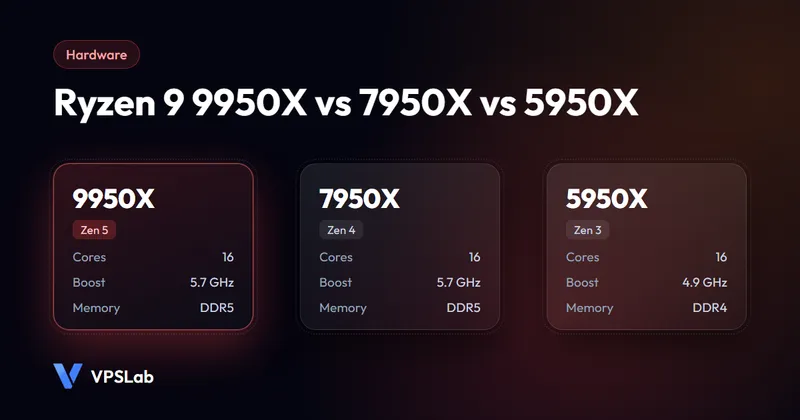
"Ryzen VPS" can mean very different hardware. A plan built on a 2020-era Ryzen 9 5950X and one built on a 2024 Ryzen 9 9950X share a name and a core count - but not much else. If you're comparing Ryzen VPS offers, the CPU generation is one of the first things to check.
This article compares the three 16-core Ryzen 9 desktop flagships using AMD's published specifications, and explains which differences actually matter on a virtual server.
The specs side by side
| Ryzen 9 5950X | Ryzen 9 7950X | Ryzen 9 9950X | |
|---|---|---|---|
| Architecture | Zen 3 | Zen 4 | Zen 5 |
| Launched | 2020 | 2022 | 2024 |
| Cores / threads | 16 / 32 | 16 / 32 | 16 / 32 |
| Base clock | 3.4 GHz | 4.5 GHz | 4.3 GHz |
| Max boost clock | 4.9 GHz | 5.7 GHz | 5.7 GHz |
| L3 cache | 64 MB | 64 MB | 64 MB |
| Memory | DDR4 | DDR5 | DDR5 |
| PCIe | 4.0 | 5.0 | 5.0 |
| AVX-512 | No | Yes | Yes (full 512-bit datapath) |
| Default TDP | 105 W | 170 W | 170 W |
For reference, the 12-core Ryzen 9 9900X uses the same Zen 5 architecture with 12 cores / 24 threads and a 5.6 GHz maximum boost.
What actually changes between generations
1. Work per clock (IPC)
Each generation does more work per clock cycle. AMD quoted roughly 19% higher IPC for Zen 3 over Zen 2, about 13% for Zen 4 over Zen 3, and about 16% for Zen 5 over Zen 4. Combined with higher clocks, single-threaded performance has moved a long way since the 5950X.
For a VPS this matters because a surprising amount of real-world work is single-threaded or lightly threaded: a PHP or Python request, a database query, a build step, a trading bot's decision loop. Faster cores mean lower latency for each of those.
2. Clock speed
The 7950X and 9950X both boost to 5.7 GHz - about 16% higher than the 5950X's 4.9 GHz peak. Sustained clocks on a server depend on cooling, power limits and how many cores are busy, so treat the boost figure as a ceiling rather than a promise.
3. DDR5 memory
The jump from DDR4 (5950X) to DDR5 (7950X and 9950X) brings significantly more memory bandwidth. Memory-hungry workloads - databases, in-memory caches, analytics, large builds - benefit most. Some platforms, including VPSLab's Ryzen nodes, pair this with ECC memory to detect and correct single-bit errors on long-running servers.
4. AVX-512
AVX-512 instructions accelerate certain vectorised workloads: some compression and encryption libraries, scientific code, media processing and machine-learning inference. The 5950X lacks AVX-512 entirely. Zen 4 added it by processing 512-bit operations in two 256-bit halves; Zen 5 on desktop parts like the 9950X executes them on a full 512-bit datapath. If your software uses AVX-512, the 9950X is the strongest of the three.
5. Platform: PCIe 5.0 and newer NVMe
The AM5 platform (7950X, 9950X) supports PCIe 5.0, while AM4 (5950X) tops out at PCIe 4.0. On a VPS the storage you get is decided by the provider's drives and RAID setup rather than the CPU alone - so check the storage spec of the plan itself (for example, NVMe Gen4 vs SATA SSD).
What matters more than the CPU model
Even the fastest CPU can be let down by the rest of the plan. When comparing Ryzen VPS offers, also check:
- Dedicated vs shared cores. Are your vCores pinned to physical cores, or shared with other customers?
- Memory type. DDR5, and whether it's ECC.
- Storage. NVMe Gen4 vs older SATA SSDs - and whether it's local RAID.
- Network. Port speed (1 vs 10 Gbit/s) and the monthly traffic allowance.
- DDoS protection - included, or an extra cost?
Which one should you choose?
- 9950X (Zen 5): the best single-threaded speed and AVX-512 support of the three - the right choice for CI/CD runners, databases, latency-sensitive APIs and trading tools.
- 7950X (Zen 4): still very fast with DDR5 and 5.7 GHz boost; a reasonable option if the price difference is large.
- 5950X (Zen 3): capable for general hosting, but noticeably behind in per-core speed and memory bandwidth.
How VPSLab's Ryzen VPS is built
VPSLab's Ryzen 9 9950X VPS runs on dedicated Zen 5 cores with DDR5 ECC memory, NVMe Gen4 storage and a 10 Gbit/s port, with premium DDoS protection included. Plans range from 2 to 12 vCores, starting at €9.99/month.
Frequently asked questions
Is the Ryzen 9 9950X good for a VPS? Yes. Its high boost clocks and Zen 5 IPC make it one of the fastest CPUs for single-threaded server workloads, which covers most web, database and automation tasks.
Do I get all 16 cores on a Ryzen VPS? No - a VPS gives you a share of the machine. What matters is how many vCores your plan includes and whether they are dedicated to you.
Is Zen 5 faster than Zen 4 at the same clock? Yes. AMD's own figure is roughly a 16% average IPC improvement for Zen 5 over Zen 4, though the gain varies by workload.
See the plans: Ryzen 9 9950X VPS hosting - or compare with our Linux VPS and Windows RDP lines.
Ready to deploy your own VPS?
Privacy-first hosting with crypto payments and instant setup.
Related articles
How to Choose a No-KYC VPS Provider: A Practical Checklist
Not every 'no-KYC' host is what it claims. Use this checklist to compare no-KYC VPS providers on signup, payments, terms, logging and reliability.
How to Connect to a Windows RDP Server (Windows, Mac, Linux, Android & iOS)
Connect to a Windows RDP server or VPS from Windows, macOS, Linux, Android or iOS, step by step - plus fixes for the most common RDP errors.
How to Pay for a VPS with Monero (XMR): Step-by-Step Guide
Pay for VPS hosting privately with Monero: choose a wallet, get XMR, send the exact amount at checkout and avoid the mistakes that delay deployment.